A prolonged signal
CJC-1295 bound to albumin
The chemistry made a growth-hormone signal last longer. The claims about sleep, muscle and recovery spread much further.
The attachment that prolongs action
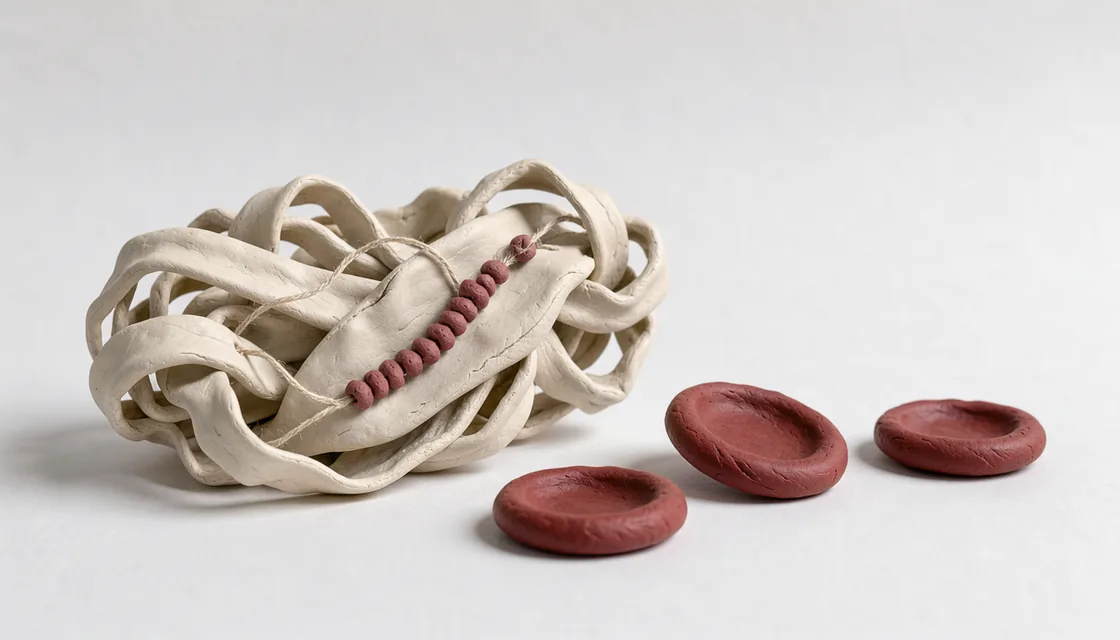
The albumin attachment is a neat piece of engineering. I appreciate CJC-1295’s solution to the duration problem. CJC-1295 was developed from the active portion of growth-hormone-releasing hormone, with changes intended to protect it from rapid breakdown. The DAC form adds a way to attach to circulating albumin. A large, familiar blood protein becomes the means of prolonging a small peptide’s presence.
CJC-1295 stimulates the pituitary, the gland beneath the brain, to release growth hormone. IGF-1, another growth-related hormone, rises downstream. The review of growth-hormone-releasing hormone and its analogues places this design within the larger effort to make hormone signals last longer.
The term no-DAC usually refers to Modified GRF (1-29), which retains protective substitutions but lacks that albumin attachment. It acts for less time. Treating the two names as interchangeable erases the very design feature that made the longer-acting research interesting.
Hormone studies in volunteers
In the early healthy-adult study, mean growth hormone increased twofold to tenfold for at least six days. IGF-1 remained elevated for nine to eleven days; after repeated research administration, the elevation persisted for as long as twenty-eight days.
A separate small study in healthy men found that growth-hormone pulses persisted. A higher overall hormone level could coexist with the ordinary rise and fall of secretion. The finding explains something about pituitary behaviour under sustained stimulation.
These results establish a pharmacological effect. Claims of stronger muscles, better sleep or faster recovery demand another journey from those blood measurements. I cannot follow that journey on the evidence described here. The studies described here did not establish those benefits.
Blood proteins and identification
The quieter follow-up is worth a place beside the hormone figures. A study of 11 healthy young men found changes in several blood proteins, with some signals correlating with IGF-1. That is a search for biological markers of the drug’s action; it supplies another way to observe the response.
Then the literature takes a different turn. Investigators identified CJC-1295 in an unknown pharmaceutical preparation using analytical chemistry, in an anti-doping context. The intended ingredient and the contents of a preparation become separate questions. This is an especially revealing turn in the record: the same compound appears in work on prolonging a hormone signal and in work on identifying an unknown mixture.
Sleep and training reports
People describe deeper sleep, less post-training soreness, gradual fat loss or more energy. They also describe puffiness, tingling hands, headache, fatigue and higher blood sugar. These are anecdotal accounts, not clinical evidence for either a benefit or an incidence of harm.
Some accounts involve several substances, changes in training or altered eating. An improvement in that setting has several possible explanations. I want CJC-1295 tested against sleep and recovery themselves, with the accompanying changes separated out. A growing list of reported effects makes that experiment more necessary.
Approval and lasting safety
CJC-1295 is not approved for human use. The available healthy-adult work is small and largely concerned with hormone behaviour. The sustained hormone elevations and wider GHRH-analogue pharmacology give reasons to consider fluid retention, blood-sugar effects and unwanted tissue growth. Their frequency and long-term consequences with CJC-1295 have not been established in large trials.
Product identity adds a separate uncertainty, illustrated by the analysis of the unknown preparation. Research amounts describe an experiment and supply no personal treatment instructions. CJC-1295’s engineering impresses me; the daily-life claims still need their own clinical work.